
How to make up after a fight: a calm way back to each other
Every couple fights. What matters is how you come back from it. Here's a calm way back: how to cool down without walking out, six steps to make up, phrases that defuse things, what a good apology has in it, and when a fight is a sign you need more help.
First, cool down
When a fight heats up, your body treats it like a threat: your heart races and listening gets almost impossible. No good conversation happens in that state. So the first step is a break, said out loud:
- Name it: "I'm too wound up to talk well. Can we stop for a bit?"
- Say when you'll come back: "Let's try again after dinner." A break with a time is a pause; a break without one feels like walking out.
- Calm down for real: a walk, a shower, music. Not replaying the argument in your head with better lines.
- Give it time: often at least twenty minutes, sometimes a night's sleep.
Six steps back to each other
- Come back when you said you would. Keeping that promise is the first repair.
- Start soft. "I hated how that went. I want to understand you." Not "so, about what you said".
- Each tell your side, one at a time. The listener's only job is to understand, then summarise: "So you felt…". Not to defend.
- Own your part. There's almost always something: a tone, a dig, a thing you said to win. Name it without "but".
- Agree on one thing for next time. Small and concrete: "When I'm tired I'll say so before we talk about money."
- Reconnect. A hug, a walk, dinner together, a silly film. Close the fight with something warm, so it doesn't just fade out.
Repair phrases that defuse things
The Gottman Institute calls these repair attempts: anything, serious or silly, that stops negativity from spiralling. Couples who make them, and accept them, do better. A few that work, even mid-argument:
- "Can we start this again?"
- "I'm on your side here. We're on the same team."
- "I think I'm getting defensive. Give me a second."
- "You're right about that part."
- "Can you say that more gently? I want to hear it."
- "What do you need from me right now?"
- "I love you, even while I'm annoyed."
- "Let's take a break and come back in half an hour."
And one to avoid: "calm down". It has never calmed anyone down.
What a good apology has in it
- What you did, specifically: "I'm sorry I brought up your mother."
- That you see how it landed: "That was unfair, and I can see it hurt."
- No "but": "I'm sorry, but you…" cancels the first half.
- What you'll do differently, if there's something to do.
Apologising for your part isn't admitting the whole fight was your fault. It just makes it easier for the other person to do the same.
What makes it worse
- Bringing up old fights. One argument at a time.
- Trying to win. If one of you wins, you both lose a little.
- Days of silence. Space is fine; punishment isn't.
- Making up without talking. Hugging it out without the conversation means the same fight comes back.
When the same fight keeps coming back
Many couples have one or two arguments that return every few months: money, chores, families, sex, time. They're often about something deeper than the topic, like feeling respected, safe or free. Next time it comes up, try asking what it means to each of you, not only what to do about it. For the ones about desire, here's what helps when one of you wants more.
When to get help
If fights are constant, if they're full of contempt or insults, or if you can't make up anymore, a couples therapist can help you find a better way to argue. And if you're ever afraid of your partner, that isn't a normal fight: talk to someone you trust or a domestic abuse helpline in your country.
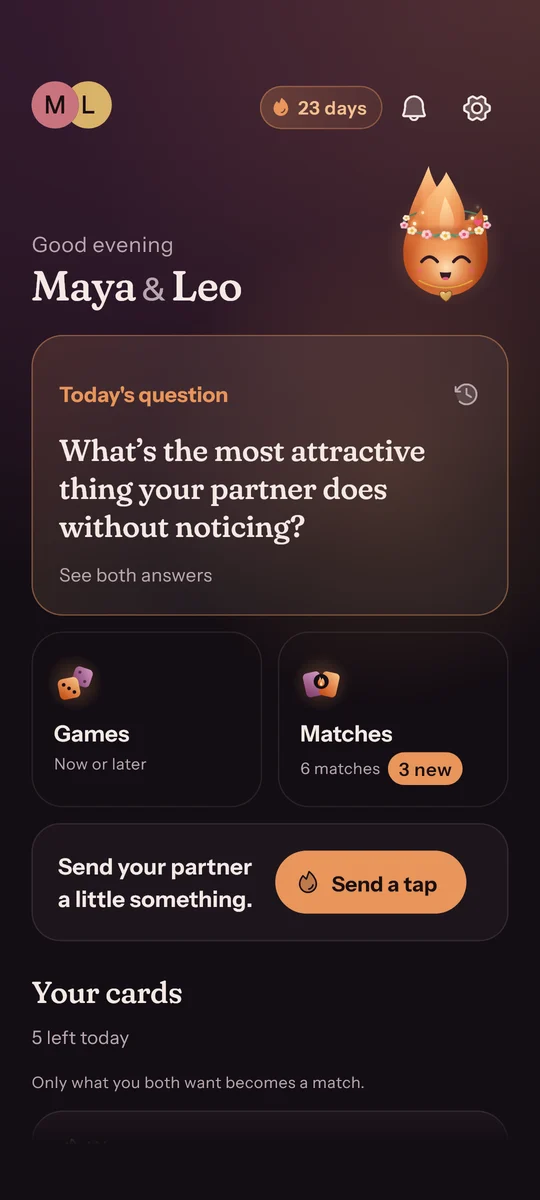
A small way back, the day after
After a fight, starting again is the hard part. In La Brasa, a tap like "Thinking of you", a kiss or a wink lands on your partner's phone without anyone having to find the words first, and the day's question gives you something easy to talk about again. Small, but it counts.
Get it on Google PlayQuestions
How long should you wait to make up after a fight?
Long enough for both of you to be calm, which is often at least 20 minutes and sometimes a night's sleep. Say when you'll come back to it, so the break doesn't feel like walking out, and don't let it turn into days of silence.
Who should apologise first after a fight?
Whoever is ready first. An apology for your part isn't admitting the whole fight was your fault. Starting with "I'm sorry I raised my voice" often makes it easier for the other person to own their part too.
What is a repair attempt?
A term from the Gottman Institute for anything, serious or silly, that stops a fight from getting worse: a joke, a hand on the arm, "can we start again?", "I'm on your side". Couples who make and accept these during conflict tend to do better over time.