
Mismatched libido: when one of you wants more, and what actually helps
One of you would like more sex than you're having; the other is fine as things are, or feels a little under pressure. It's one of the most common reasons couples go to therapy, and it doesn't mean anything is broken. Here's what's going on, and what couples who handle it well actually do.
A gap, not a fault
Researchers call it desire discrepancy: a difference between how much each of you wants sex. It's relative. Nobody's level is "normal" and the other's "wrong", and the person who wants less isn't the problem any more than the person who wants more. A review by the sex researcher Kristen Mark describes it as common at one time or another in long-term relationships, and a bigger gap tends to go with lower sexual and relationship satisfaction. That's the reason to deal with it, not to panic about it.
Both sides hurt. The one who wants more can feel unwanted, or tired of always being the one who asks. The one who wants less can feel guilty, or that every hug has become a question. Saying both feelings out loud is a good place to start.
Two kinds of desire
Some desire arrives out of the blue: you think of your partner and you want them. Some only shows up once things have started: a kiss, closeness, time together. In 2000 the physician Rosemary Basson described this second, responsive kind, which many people recognise, especially in long relationships. The sex educator Emily Nagoski made the two names famous in her book Come as You Are: spontaneous desire and responsive desire.
Neither is better. But if one of you mostly has responsive desire, waiting to "feel like it" first can mean waiting a long time. Unhurried time close together, with no pressure for it to go anywhere, is often where desire starts.
What actually helps, according to couples who've been there
In 2020, the researchers Laura Vowels and Kristen Mark asked 229 people in long-term relationships what they did when their desire didn't match, and how much it helped. The things done together (talking about it, being close or trying something different together, even just cuddling or showering together) were the ones most often rated very helpful, and they went with higher sexual and relationship satisfaction than going it alone. Some people also said they sometimes had sex anyway, for the relationship; that only works when it's freely chosen, never as a duty.
Doing nothing came last. Of those who mostly waited for it to pass, about one in ten found that very helpful.
Five things to try
- Talk about it away from the bedroom. On a walk or over coffee, never straight after a no. Start with what you like about your life together. Here's how to bring it up.
- Make affection safe again. Agree out loud that a kiss, a cuddle or a shower together can be just that. When every touch might be a question, people stop touching.
- Make time to be close, not to perform. A night with the phones in another room, a massage with no agenda. For responsive desire, closeness is often the spark.
- Find your overlap. Write down what you'd each enjoy, separately, and compare only the matches. Our printable yes, no, maybe list is made for that.
- Stop counting. In a study of more than 30,000 people, well-being rose with how often couples had sex, but only up to about once a week; beyond that, more wasn't linked to happier (Muise and colleagues, 2016). There's no number you're failing to reach.
Questions to talk it through
Take turns, answer honestly, and don't try to fix anything on the spot. The point is to understand each other.
- When do you feel most like being close to me?
- What gets in the way: tiredness, stress, timing, or something else?
- What would affection with no strings attached look like for you?
- What would make it easier for you to say yes, or to say no?
- What does "more" or "less" mean to you in practice?
- Is there something we used to do that you miss?
When to get help
If the gap is causing real distress, if desire changed suddenly, or if sex hurts, talk to a doctor: health, medication and mood can all affect desire, and some causes are treatable. A couples or sex therapist can help with the rest. You won't be their first: a difference in desire is among the main reasons couples see one.
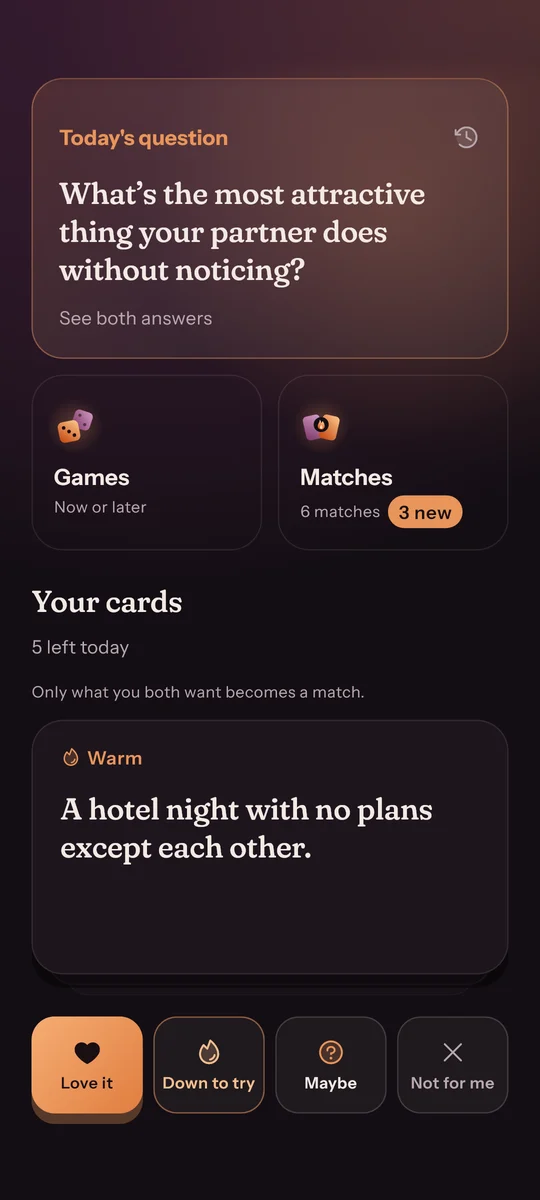
Each of you at your own level
In La Brasa, each of you sets your own heat level, from Mild to Fiery. You're only dealt cards up to your own level, the daily question follows the lower of your two, and you rate everything privately. A card becomes a match only when you both say Love it or Down to try, and nobody ever sees the other's no. The one who wants more never has to push, and the one who wants less never has to refuse out loud.
Get it on Google PlayQuestions
Is it normal for one partner to want sex more than the other?
Yes. A difference in desire is common at one time or another in long-term relationships, and it's among the main reasons couples go to therapy. It doesn't mean either of you is broken, and levels move over time.
How often should a couple have sex?
There's no right number. In a study of more than 30,000 people, well-being rose with how often couples had sex, but only up to about once a week; more than that wasn't linked to more happiness. What matters is a rhythm you're both glad about.
Can desire come back in a long relationship?
Often, yes. For many people desire is responsive: it shows up once closeness has started rather than before. Unhurried time together with no pressure for it to go anywhere, and talking about what you'd both enjoy, help. If desire changed suddenly or it worries you, see a doctor or a sex therapist.
Sources
- Mark (2015), Sexual desire discrepancy, Current Sexual Health Reports
- Vowels and Mark (2020), Strategies for mitigating sexual desire discrepancy in relationships, Archives of Sexual Behavior
- Basson (2000), The female sexual response: a different model, Journal of Sex and Marital Therapy
- Muise, Schimmack and Impett (2016), Sexual frequency predicts greater well-being, but more is not always better