
The yes, no, maybe list for couples: 41 gentle ideas to print
A yes, no, maybe list is the easiest way to find out what you'd both enjoy without anyone having to ask first. Each of you goes through the same ideas on your own and marks each one yes, no or maybe. Then you compare, and look only at what you both said yes or maybe to.
This one stays gentle: 41 ideas from mild to warm (kisses, words, touch, play, dates and small rituals), the same kind of ideas as the first levels in La Brasa. You can fill it in right here or print it.
Where the idea comes from
Sex educators and campus health services hand out yes, no, maybe lists to help people work out what they want and where their limits are before they talk about it. The best-known version is Scarleteen's "Yes, No, Maybe So", by Heather Corinna and CJ Turett, which is far longer and far more explicit than this one. The idea is the same: when you know your own answers first, the conversation gets easier, and a list hands you words you might not have found on your own.
How to use it
- Make two copies. Print it twice, or each fill it in on your own phone.
- Fill it in alone, honestly. Mark what you would enjoy, not what you think your partner wants to hear. Skip anything you'd rather not answer.
- Compare only where you overlap. Look for the ideas you both marked yes, or one yes and one maybe. Agree before you start that a no needs no reason.
- Talk about the maybes. Ask what would make it a yes: another moment, going slower, a gentler version.
- Pick one and plan it. A match you don't plan stays on paper. Choose one for this week and decide when.
- Do it again in a few months. Answers change, and that's part of the fun.
Three rules that keep it kind
- A no is a complete answer. No reasons, and no trying to change it that night.
- A maybe isn't a promise. It means "maybe, if…", so ask about the if.
- Anyone can change an answer, any time, a yes included.
The list
Tick yes, maybe or no for each idea. Nothing you tick leaves your screen. Printing keeps your ticks, and the print sheet can save a PDF instead.
What to do with your matches
Start with the ideas you both marked yes: they're the easy wins. Pick one for this week and put it in the calendar, even loosely. Then go through the yes and maybe pairs and ask the maybe what would help. Tonight, the weekend, or someday all count, as long as it's decided.
If you matched on very little, that's information, not a verdict. Wanting different amounts or different things is common, and there are good ways through it: here's what helps when one of you wants more. And if the hard part is starting the conversation at all, read how to talk to your partner about what you want.
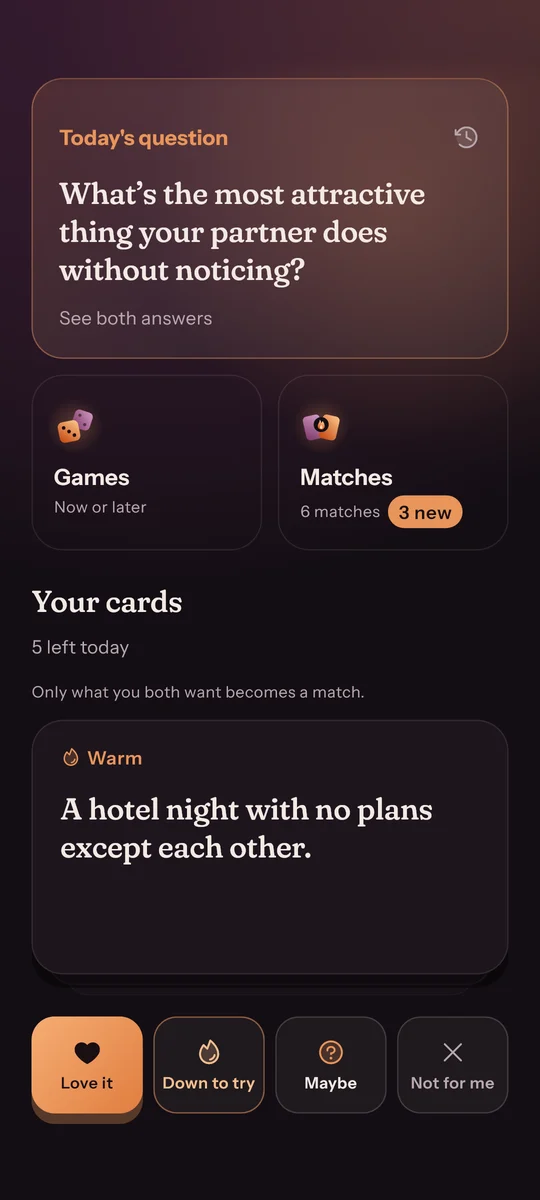
The same idea, without anyone seeing a lone yes
On paper, someone has to look at both sheets. In La Brasa, the app does the comparing: each day you each rate new cards privately (Love it, Down to try, Maybe or Not for me), and a card only becomes a match when you both say Love it or Down to try. A maybe stays yours, and your partner never sees what you passed on. Each of you picks your own level, from Mild to Fiery, so nobody is shown more than they asked for.
Get it on Google PlayWant to see how other apps handle it? Our comparison of couples apps covers the ones built on yes, no and maybe.
Questions
What is a yes, no, maybe list?
A list of ideas that each partner marks privately as yes, no or maybe, and then compares. Sex educators use them to help people work out what they want and where their limits are before talking about it. This one stays gentle: kisses, touch, words, play, dates and small rituals.
How do you use a yes, no, maybe list with your partner?
Fill it in separately and honestly, then compare only where you both said yes or maybe. Never ask about a no, ask what would turn a maybe into a yes, and pick one match to plan this week. Do it again in a few months, because answers change.
Is there an app that works like a yes, no, maybe list?
Yes. In La Brasa you each rate new cards every day, privately, and a card only shows up for both of you when you both want it, so nobody sees a lone yes or a no. Other apps built on the same idea include Yes No Maybe and Spicer; our comparison of couples apps covers them.