
How to talk to your partner about what you want in bed
Most couples find it easier to do things together than to talk about them. Saying out loud what you'd like, or what you'd like to try, can feel risky: what if they say no, or think less of you? Here's how to make that conversation easier, and even fun.
Why it feels so hard
Talking about desire puts two fears side by side: the fear of being rejected, and the fear of making your partner feel they've been doing something wrong. Neither is usually true. Most people are relieved when their partner opens the door, because it means they can say what they want too.
It also helps to remember that wanting something isn't a demand. "I've been curious about…" is an invitation your partner can accept, change, or decline.
Pick the right moment
- Not in the middle of it. Mid-moment feedback can feel like criticism. A calm, unrelated moment works better: a walk, a lazy morning, a long drive.
- Not right after a disappointment. If something didn't go well, wait a day. Lead with what you enjoy, not with what went wrong.
- Side by side beats face to face. Many people find it easier to talk while walking or cooking, without intense eye contact.
Start with what you already love
Begin with something specific you enjoy about your intimate life. It sets a warm tone and tells your partner this is about adding something, not fixing something.
Try: "I love it when you… I've been thinking it'd be fun to try something new together too. Can I tell you about it?"
Use curious, open language
- "I've been curious about…" instead of "I want you to…"
- "Would you ever be up for…?" instead of "Why don't we ever…?"
- "What's something you've wanted to try?" Give your partner the same space you're asking for.
Make "no" easy
A conversation about desire only works if both people feel free to say no without it becoming a big deal. Say it explicitly: "If it's not for you, that's completely fine. I just wanted to share." Paradoxically, making "no" easy is what makes "yes" more likely; nobody likes to feel cornered.
A useful middle ground is "maybe": something you'd consider with the right mood, the right pace, or a few conditions. Most new things start as a maybe.
Agree on a few simple rules
- Either of you can pause or stop anything, any time, with no explanation needed.
- Trying something once doesn't mean doing it again.
- Talk about how it went afterwards, kindly: what you liked, what you'd change.
If talking is still too awkward, play first
Games take the pressure off. A round of would you rather or a list of questions to ask each other can surface desires without anyone having to start the conversation. Laughing together is a great way in.
Another approach is to write things down separately and compare. Each of you marks ideas as yes, maybe or no, and then you look only at the ones you both said yes or maybe to. Nobody has to say their "no" out loud, and nobody is left with a lonely "yes". To start, use our printable yes, no, maybe list.
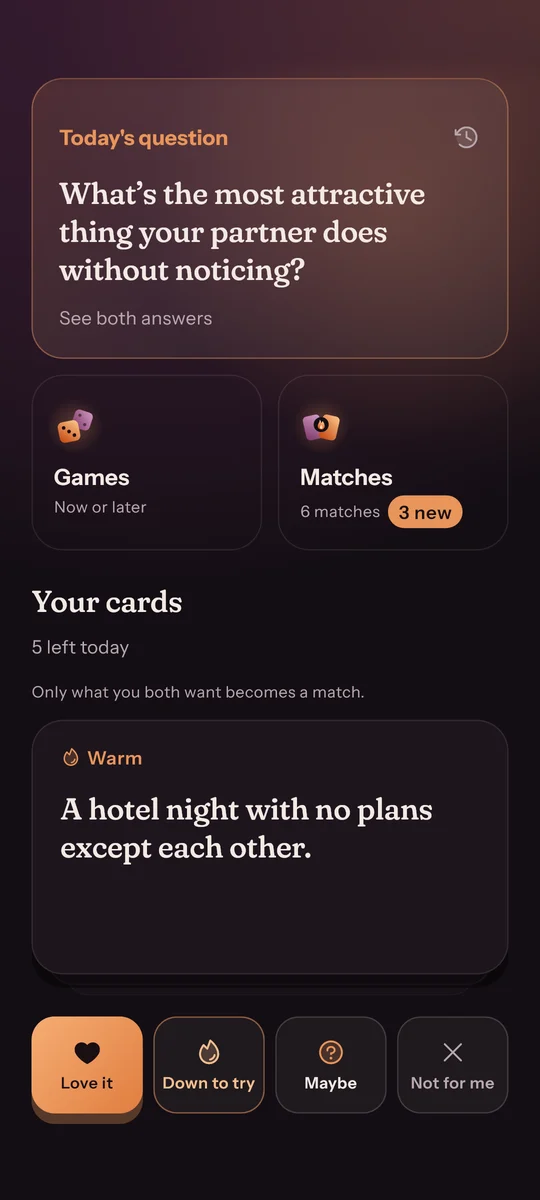
That's exactly how La Brasa works
In La Brasa, you each rate ideas privately, from mild to fiery, at the level you choose. A card shows up for both of you only when you both want it. Your partner never sees what you passed on. From there you can plan it for tonight, the weekend, or someday, and say how it went.
It turns the hardest conversation into the easiest one: you already know you both want it.
Get it on Google PlayNot ready yet? Take the spice-type quiz first.